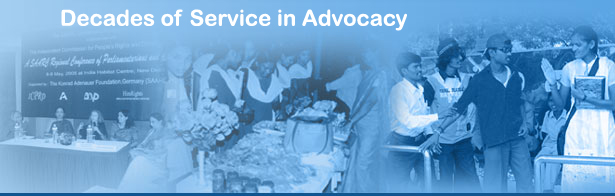
The Independent Commission for People’s Rights and Development, (ICPRD) has evolved since 1997 as a national advocacy coalition (non-profit sector) that aims to strengthen the solidarity and advocacy base of Special and vulnerable constituencies for rights and development during the period of economic reform. The process is towards facilitation of resource transfers in an effort to deepen democracy.
ICPRD activities are in the following niche areas:
- Policy Advocacy
- Mobilization at the grassroots
- Capacity Building
- Training Technologies and Aids
- Action/Attitudinal Research
- Coalition Building and Network Development
About 600 events have been taken up in these areas in the last 10 years.
Over 10000 stakeholders in policy advocacy from the categories listed below have contributed to the above advocacy and intermediation process through interface & coalescing systems in over 21 states of India. These are:
- About 900 small rural CBOs/NGOs from 158 districts across 21 states of India have been involved in various activities (around 160 activities).
- 60 Senior State Development Managers such as Secretaries / Joint Secretaries of Rural Development, Such as Planning Commission (Deputy Chairman / Member Secretaries / Member’s), Banking, Small Scale Enterprises Ministry / Depts. of the Government of India, P.M.O. apart from bankers, financial institutions (NABARD, SIDBI, RMK) Statutory bodies Minorities Commission (Chairperson), NHRC (Member); Autonomous bodies such as NLI, NIPCCD, NCERT, BIRD, CAPART, CSWB etc.
- 70 MPs/MLAs, in India and 11 SAARC / European MPs.
- 105 Technical experts / Academia, universities
- 250 members of the National / local media
- Distinguished Police officers, security personnel, eminent academicians/intellectuals.
In addition:
- 3400 poor and tribal women approximately have been trained and their capacities built.
- 30,000 stakeholders have been reached through our various programmes and activities that include Panchayat members, Village Heads, Teachers, Anganwadi workers, Women’s Groups, Youth Groups, etc.
Interventions
A range of interventions, have been utilized until now towards the process. These are:
1. Undertaking coalition/alliance building as a strategy for pro poor advocacy and mobilization. Linking the national/policy level – with grassroots initiatives with a view for the poor to contribute and participate in decisions that govern their lives (policy changes). (SAARC levels have also been engaged with) Network and Coalition building as a service facility for inter mediation of rights / development issues amongst the poor, women, tribals, dalits, minorities etc. or for Human crisis response mechanisms with different stakeholders to influence the process. (For eg. Farmers’ suicide victims).
2. Exploring NGO - Governance relationships through interface Organizing public hearings as pro-poor watch processes to ensure access transparency/accountability of public policies and programs for the poor, recognized and considered a planning and political necessity. Advocacy and round tables with MPs/ MLAs on a variety of issues or with governments – focusing on deepening democracy, ensuringa ccountability, enhancing the role of civil society in planning governance etc. Citizens Report Cards on Development by State is also a niche area. The only civil society Organization to have reached 70 MPs/MLAs.
3. Identifying, interfacing and training NGOsat the state level through a consultative process, thus developing district and state level NGO alliances /social capital especially for ‘accessing’ and generating a demand; and building capacity to monitor poverty programs at village / tehsil / district levels. Training to build advocates and groups in unserved areas to generate a demand for resource transfers in poor communities. (or marginalized constituencies)
4. Development of research/ documentation as an instrument and tool for pro-poor and development advocacy. Designing training modules and participatory research through beneficiaries with the support of activist theoreticians. The first Self help group manual in Santhali language has been evolved by us (for micro – credit).
5. Strategies for reintegration of specific constituencies such as trafficked women, youth, dalits, tribals (including primitive tribals), bonded child labour, drought affected suicide victims (economic & social). Umbrella federation with over 900 NGOs currently linked to poor and remote locations - identified, interfaced and coalesced (detailed database available for such groups with ICPRD).
ICPRD niche areas to recap are:
- Training to build advocates and groups in unserved areas to generate a demand for resource transfers in poor communities, (or marginalized constituencies). Pro- Poor Planning / Gender Training with a practical orientation to mainstream agencies / institutions. (such as Jharkhand, Orissa, Bihar, M.P., A.P., Karnataka, Tamilnadu etc.)
- Umbrella federation with over 900 NGOs currently linked to poor and remote locations - identified, interfaced and coalesced (detailed database often available for such groups with ICPRD). (focused on Central/South/East India)
- Training young men as advocates against Gender violence. (Research/ data base through detailed & latest techniques – actionresearch). (Karnataka/ Rajasthan)
- Network and Coalition building as a service facility for inter mediation of rights/ development issues amongst the poor, women, tribals, dalits, minorities etc. or for Human crisis response mechanisms.) (Andhra Pradesh, Central India)
- Advocacy and round tables with MPs/MLAs on a variety of issues or with governments – focusing on deepening democracy, ensuring accountability, enhancing the role of civil society including governance, etc.
- Citizens’ Report Cards on Development by State - Karnataka, Rajasthan, Orissa, Puducherry.
- Training tribal women as social entrepreneurs in areas unserved by financial institutions.
|